
Criminal Court Cases in Boundary County
Boundary County belongs to Idaho's First Judicial District. The Idaho District Court hears felony cases, while its Magistrate Division handles misdemeanor cases and the early steps in felony matters. Those first steps can include an initial appearance, bond decision, and preliminary hearing. The Boundary County clerk keeps the judicial file at 6452 Kootenai Street in Bonners Ferry. Court mail goes to PO Box 419.
The court file begins when a prosecutor files a complaint or other charging paper. That makes it distinct from the arresting agency's incident report and the jail's intake sheet. The clerk can provide the register of actions, judgments, available pleadings, certified copies, and eligible audio. For court help, call 208-267-5504 or email courts@boundary.idcourts.gov. The public counter is listed as open Monday through Friday, 9 a.m. to 5 p.m.
Boundary County Court Divisions
Idaho does not divide felonies into numbered classes. Each offense statute supplies its own maximum term, so the charge text and statute number on a Boundary County case matter more than a borrowed Class A or Class B label. A felony proceeds in District Court. A misdemeanor stays in the Magistrate Division unless it is linked to another matter.
The Magistrate Division may also hold the first felony hearings before the case moves forward. This can make one case appear to change posture without changing counties. Check the court location, case type, and register of actions before deciding which judge or division has the next event. The Idaho Courts district overview confirms Boundary County's First Judicial District placement. Its court structure image gives useful context for why felony and misdemeanor entries can appear within the same statewide system.
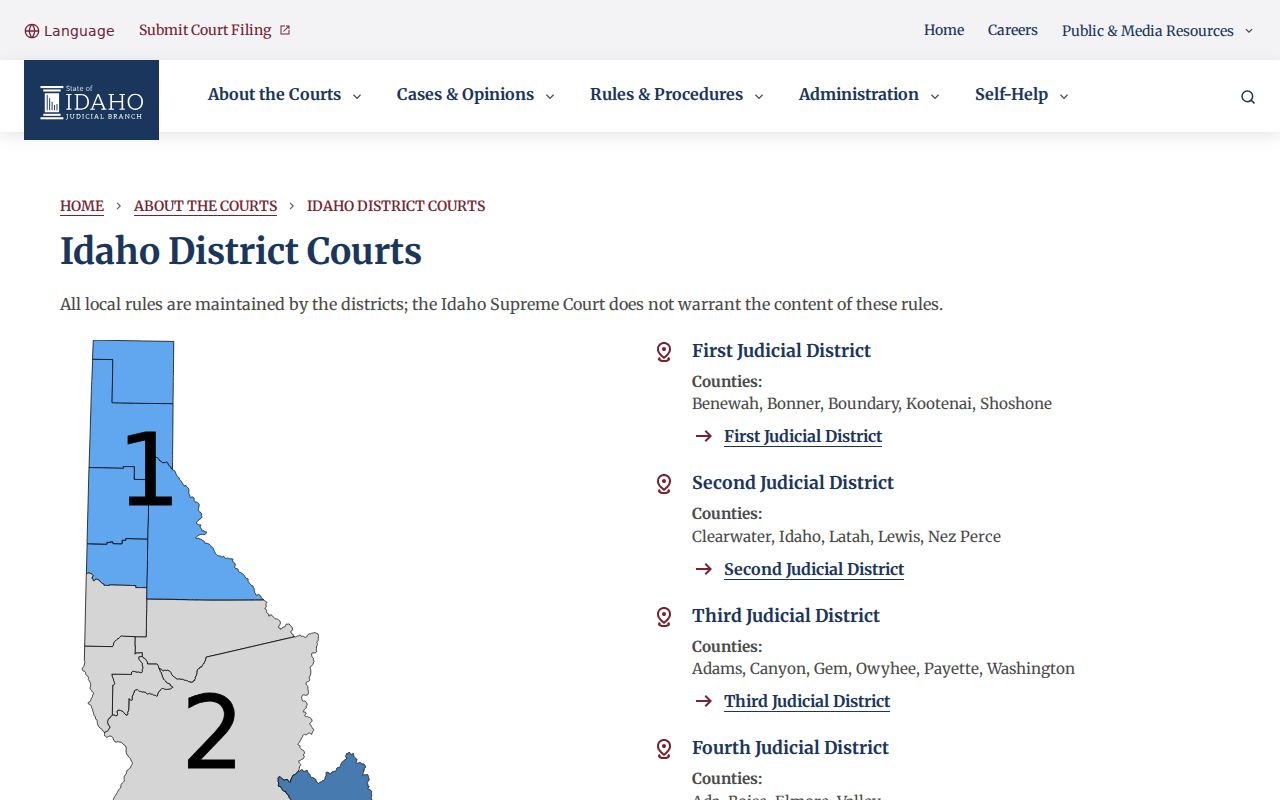
The statewide structure directs the searcher to the right local division, while the Boundary County clerk remains the source for the actual case file.
Boundary County Case Record Searches
Start with the Idaho iCourt Portal and Smart Search. Public search does not require registration. A full case number is the best locator. When only a name is known, limit the location to Boundary County and compare filing date and case type. Common names can produce unrelated people, and portal results do not positively prove identity.
- Open Smart Search and accept any current terms.
- Enter the complete case number, or search the party name.
- Set Location to Boundary County and add a case-type or date filter when useful.
- Open the matching summary and read the register of actions.
- Give the case number and exact document or hearing date to the Boundary County clerk.
| Field | Type | Required | Use |
|---|---|---|---|
| Search Criteria | Text | Yes | Party name or case number |
| Location | Dropdown | No | Select Boundary County |
| Case Type | Dropdown | No | Narrow criminal or traffic results |
| Date range | Dates | No | Separate similar names |
| reCAPTCHA | Check | When shown | Limits automated access |
Note: A no-result search may reflect a new, sealed, federal, older, or differently spelled Boundary County case.
Boundary County Clerk File Requests
The portal is an index and summary tool. It does not promise a downloadable image of each pleading. Idaho Courts sends readers to the filing county's clerk or a courthouse kiosk when the public portal omits a document. The Idaho Courts records-access explanation shows that online, kiosk, and clerk access are separate routes.
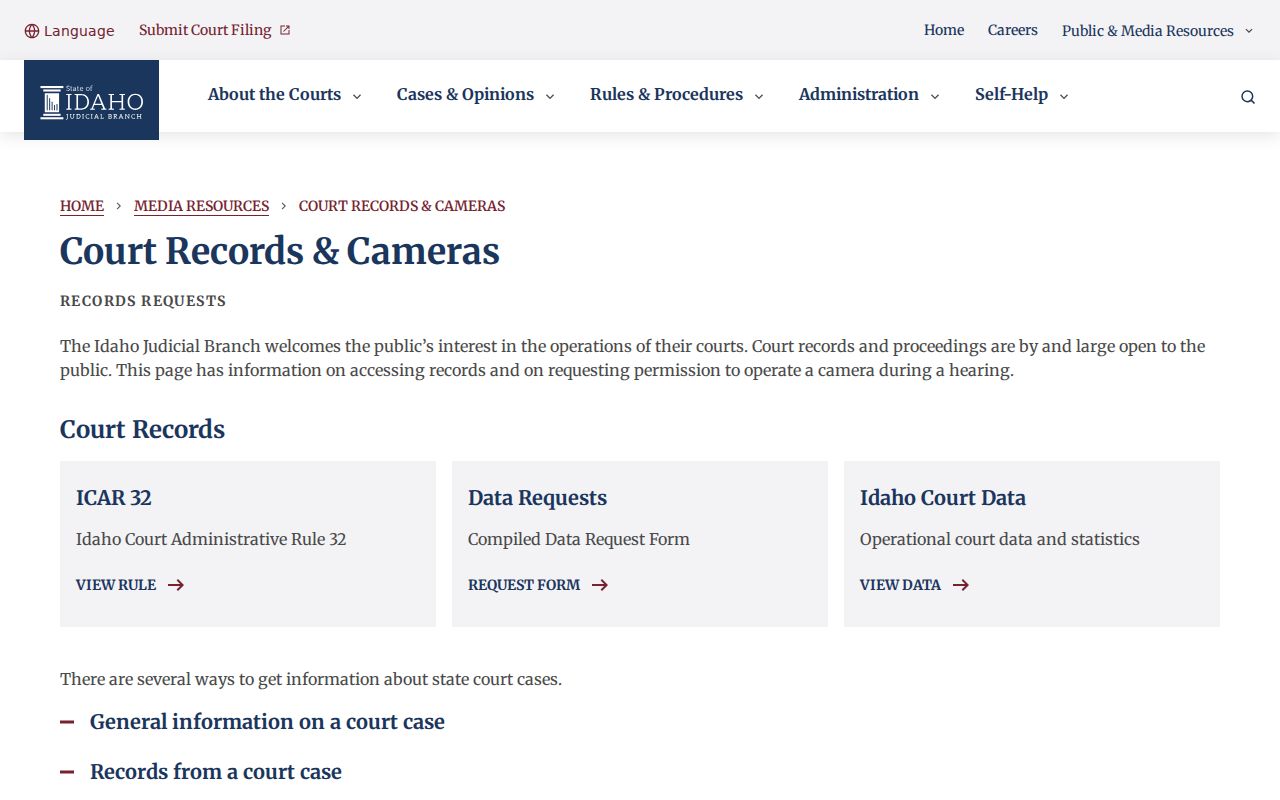
That distinction is especially useful for older files, certified copies, and hearing audio. Boundary County's court request form asks for the case number and title, specific documents and file dates, or hearing dates for audio. It offers pickup, email, or mail. Published charges are $1 per page, $1 for each certification stamp, $10 for audio on a flash drive, plus postage. Extra labor may apply under Idaho Code §74-102(10)(b) for more than 100 pages, needed redaction, or more than two hours of search and copy work.
Boundary County District Court
6452 Kootenai Street
PO Box 419
Bonners Ferry, ID 83805
208-267-5504
Monday-Friday, 9 a.m.-5 p.m.
courts@boundary.idcourts.gov
What a Criminal Case File Contains
A Boundary County case summary identifies the court event, but the filed papers give the clearest answer. Ask for the complaint when the question is what the prosecutor charged. Read the register of actions to trace hearings, motions, pleas, and later entries. Use the judgment or dismissal order for the final result. A sentence may also list custody, fines, probation, and conditions.
| Case number and court | The stable locator and the Boundary County division holding the file. |
|---|---|
| Charging document | The prosecutor's filed allegations and cited Idaho statutes. |
| Register of actions | A dated index of filings, hearings, orders, and financial events. |
| Plea and disposition | The plea entered and outcome for each filed count. |
| Judgment | The court's formal result, including dismissal, acquittal, or conviction. |
| Sentence | Custody, probation, financial terms, and other ordered conditions. |
Do not infer a final result from the complaint. Charges may be amended or dismissed, and a plea can resolve fewer counts than the initial filing lists. The complete Boundary County record should be read through the latest disposition entry.
Reading Boundary County Docket Events
The register of actions is the timeline of a Boundary County court case. An arraignment is the hearing where the accused is told the charge and enters a plea. A disposition is the result of a charge. A withheld judgment is an Idaho sentencing device that may permit later relief, but it does not mean the file never existed.
- Complaint
- The charging paper that states the alleged offense.
- Arraignment
- The plea-stage hearing after charges are filed.
- Disposition
- The outcome of each count, such as dismissal, acquittal, or conviction.
- Judgment
- The signed court record of the final result.
- Register of actions
- The chronological list of case activity.
Payment entries deserve care. Boundary County accepts certain card payments by phone and adds a 3.5 percent convenience fee. A payment receipt does not prove that a warrant was recalled or a case closed. Ask the clerk to confirm the judge's signed order and the related docket entry.
Criminal Case Stages in Boundary County
Once the prosecutor files charges, the judicial record develops in stages. A misdemeanor generally remains with the Magistrate Division. A felony begins with magistrate-level proceedings and moves through District Court if it continues. Timing varies with hearings, motions, disclosure of evidence, plea talks, trial needs, and court orders. Research did not establish a reliable Boundary County time estimate for each stage.
Case flow: Charges Filed › Arraignment › Pretrial › Plea or Trial › Disposition › Sentencing
Each stage can leave a different paper or entry. The complaint answers what was filed. The plea and minute entries show what happened in court. The final judgment and sentencing record answer how the case ended. If an appeal follows, later appellate entries may not be stored in the same way as the trial-court documents.
Boundary County's First District Bench
The Boundary County District Court page is the official local route for judges, court contact, payments, iCourt, Clean Slate information, and VINE. It also reinforces an important split: court services and record access share a local page, but custody alerts and payment tools do not replace the case docket.
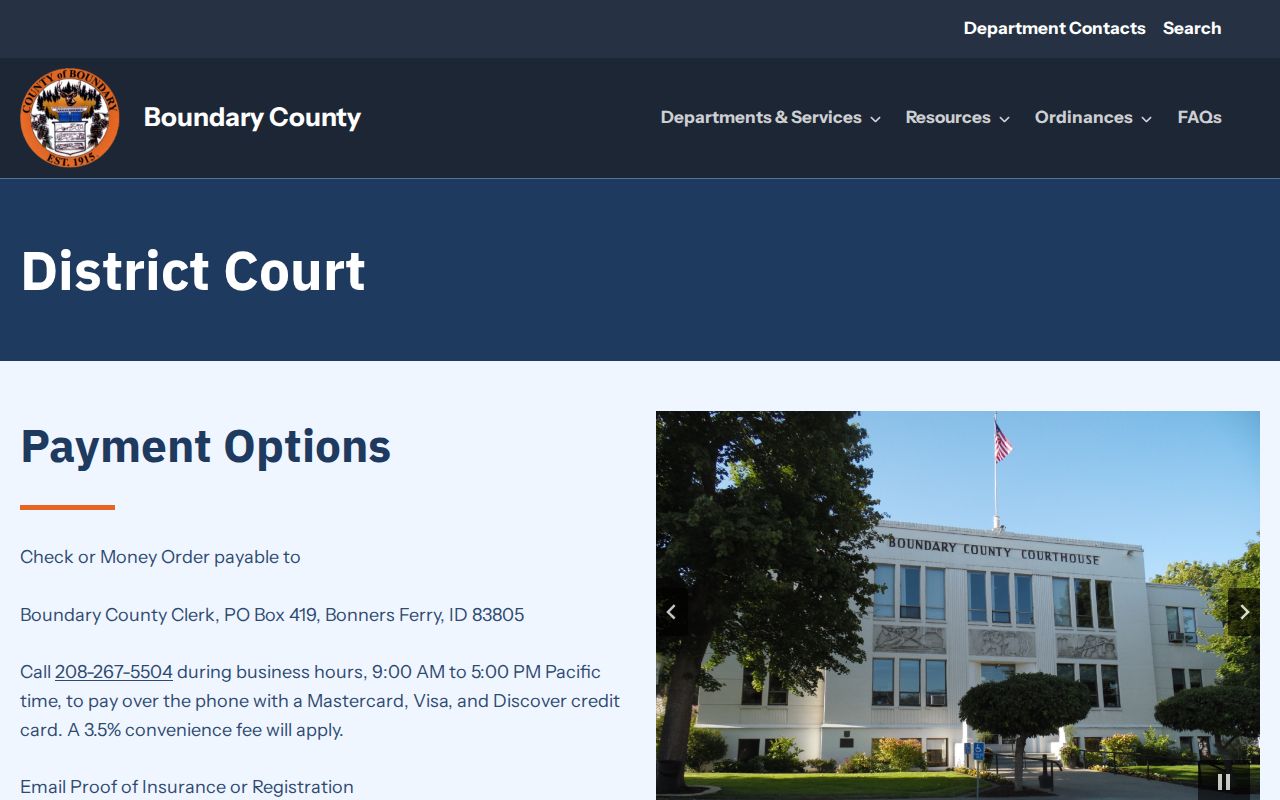
The local court page should be checked before a visit because the county is planning a courthouse move. Idaho Department of Labor reporting in March 2026 described conversion of the former Bonners Ferry Safeway into a new Boundary County Courthouse. Until the county posts final visitor instructions, confirm the current counter location by phone rather than relying on an old address alone.
Federal criminal matters are different. Boundary County lies in the U.S. District Court for the District of Idaho, but federal cases use PACER and the federal clerk, not iCourt. This difference can explain a local portal no-result when the arrest or prosecution was federal.
Access Rules for Case Records
Idaho court records are generally open, but access is not absolute. Sealed or Clean Slate-shielded cases, juvenile proceedings, victim information, medical material, and confidential documents may be missing or redacted. Online access can reveal less than a courthouse kiosk or clerk-authorized copy. Judge review may be required for a restricted request.
The court form asks a requester seeking exempt, sealed, or confidential material to state a reason or relationship and certify against illegal use. A clerk cannot lift a sealing order merely because the requester wants a complete file. Ask which public portion can be released and whether a motion or judicial review is needed for the rest.
Idaho access rule: The Idaho Public Records Act governs many agency records, while court access also follows judicial rules. Clean Slate shielding under Idaho Code §67-3014 can keep eligible case information from ordinary public view.
Choose the Right Boundary County Record
One question often requires one precise paper. For the allegation filed in court, request the complaint. For the current sequence of hearings and orders, use the register of actions. For the result, ask for the judgment, dismissal order, or sentence. For what an officer reported before filing, contact the arresting agency instead of the clerk.
This split prevents a common error. A booking charge is received at intake and can change after prosecutor review. The court case shows what was filed and decided, while the Boundary County arrest search routes readers to the agency and jail records that precede the case. For correction of a missing state disposition, obtain the certified court outcome and provide it through Idaho State Police BCI's correction process.
Be specific when ordering audio. Boundary County's form asks for the hearing date, and judge review may apply. A broad request for “the whole criminal record” can delay the answer because no single office holds every part.